Breathing Exercises for COPD
Breathing techniques can help you feel more in control of your breathing and cope better when you get out of breath.1 This page will guide you through some techniques that may help you when you feel breathless.
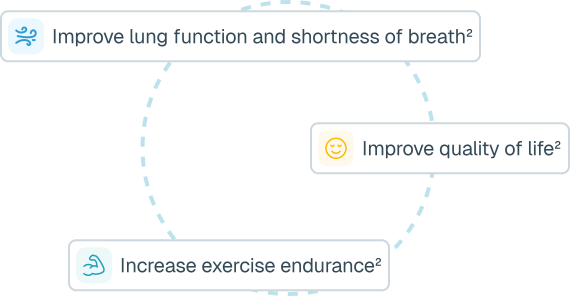
Studies have shown that breathing exercises can significantly improve lung function and shortness of breath in people with COPD, increasing exercise endurance and quality of life. Additionally, breathing exercises are a core part of a pulmonary rehabilitation programme, which your healthcare team may advise that you attend.2
Why breathing exercises for COPD help
Your diaphragm sits under your lungs and helps move air in and out. When you breathe in, your diaphragm pulls down to create space in your lungs. When you breathe out, it relaxes back into a dome shape to help push the air out.3
By strengthening your breathing muscles, you can:2

Improve your lung function

Improve your quality of life

Increase your exercise ability

Cope better during periods of breathlessness or anxiety
The more you practice, the easier these exercises will feel. To help you get started, we’ve provided some information about breathing exercises below.
Relaxed breathing
Relaxed breathing is a simple way to calm your breathing when you’re feeling out of breath or anxious. It’s best to practise this technique when you’re feeling relaxed, so you know what to do when you need it. Try it like this:4
Sit in a comfortable position with your arms supported
Relax your shoulders and let your body go loose
Place one hand on your chest and the other on your stomach
Close your eyes if you like, to help you focus
Breathe in slowly through your nose – your stomach should rise, but your chest should stay stil
Breathe out gently through your nose— your stomach should fall
Keep each breath slow and smooth — try to feel more relaxed with each breath out
Once you’ve tried the relaxed breathing technique, you might find breathing a rectangle useful. You might find it helpful to find something rectangle shaped, such as a TV, book, or window frame.4
Let your eyes trace the edges of a rectangle as you breathe—inhale along the shorter sides and exhale along the longer sides. Gradually slow the pace of your eye movements to gently slow your breathing.4
Other breathing techniques for COPD
You can combine breathing control with the following techniques during daily activities. Try them all and see which works best for you.
Pursed-lips breathing
This helps keep your airways open longer so you can get rid of more air, especially if your lungs feel ‘trapped’ with air.4
Breathe in gently through your nose
Purse your lips as if you’re blowing out a candle
Blow out gently, for as long as is comfortable — don’t force it
Blow-as-you-go
Use this when doing something active or physically challenging:4
Breathe in before the effort
Breathe out during the effort
For example:
Breathe in before you stand up, then blow out as you stand.
You can combine this with pursed-lips breathing.
Paced breathing
Helpful during steady movement, like walking or climbing stairs:4
Match your steps to your breathing
Try breathing in for one step, then out for one or two steps
Adjust the rhythm to what feels best — for example, two steps in, two steps out
You can use this with pursed-lips breathing or blow-as-you-go for added support.
Where to get help?
You’ll learn many of these techniques as part of a pulmonary rehabilitation programme. You can also find more guidance through trusted sources like Asthma + Lung UK.
Help & Support
Why not visit our help and support pages for more information on support groups.
Learn more about Help & SupportRemember: the more you practice, the more confident and in control you’ll feel.
Talk to your healthcare team if you need support or want help learning these techniques.
Abbreviations:
References:
- Asthma + Lung UK. What can you do to manage your COPD? Available at https://www.asthmaandlung.org.uk/conditions/copd-chronic-obstructive-pulmonary-disease/what-can-you-do-manage-your-copd. Accessed November 2025.
- Li Y, et al. International Journal of Chronic Obstructive Pulmonary Disease 2022; 17:3075–3085.
- Bains KNS, Kashyap S, Lappin SL. Anatomy, Thorax: Diaphragm. [Updated 2023 Jul 24]. In: StatPearls [Internet]. Treasure Island (FL): StatPearls Publishing; 2025 Jan-. Available from: https://www.ncbi.nlm.nih.gov/books/NBK519558/. Accessed November 2025.
- Asthma + Lung UK. How Can I Manage My Breathlessness? Available at: https://www.asthmaandlung.org.uk/symptoms-tests-treatments/symptoms/breathlessness/how-can-i-manage-my-breathlessness. Accessed November 2025.